Big trout and choosing the perfect spot
Large trout are never found by accident in one place. Every single size fish I have caught has taught me how strategic they are in selecting the environments in which they stop, especially marbled trout. The marbled trout is a shy, fearful, cunning and incredibly alert predator. It is rare to see it in open water unless special conditions occur. This fish prefers irregular bottoms, rich in shelters such as natural cover, inlets and water turns.
Many people ask me what are the differences between a large brown and a marmorata. Giving an unambiguous answer is not easy. In general, browns are more active than marmorates, which, when they decide to “shut down,” leave little hope. Conversely, a marmorata in full activity can prove to be one of the most aggressive fish in existence. On the valley floor, the differences between the two species are reduced, except for the marmorata’s predilection for very specific environments.
Spotting size fish always requires special attention. They are shrewd animals, and their windows of activity are short. This is true for both large brown and marbled. Their choice of hunting locations is careful, and they often detest direct light. However, in my experience, I have caught plenty of trout in high sun, proving that when it comes to fishing, there are no fixed rules.
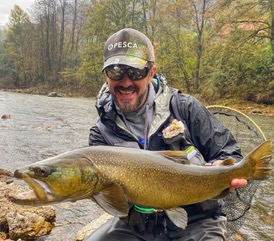
These are the fish that everyone is looking for
The three requirements of a good resting place
To choose an area, bounty fish evaluate three basic conditions:
1. Shelter: Protection from the elements and predators.
2. Food: A constant source of nourishment.
3. Energy efficiency: The location must allow the fish to gain more energy than it consumes.
When looking for a spot, it is essential to keep these points in mind. For example, I love stretches of river where one of the banks is inaccessible from land. This provides a natural refuge for fish and increases the likelihood of finding them. If there are branches extending over the water on that bank or a bottom with large boulders, the spot becomes even more promising.
The curves and great rivers of the valley floor.
In river bends, the current digs greater depths into either bank, often creating staging areas for fish. Debris accumulated from floods and slower flows are hot spots to be carefully beaten. The bank opposite the bend often has a sloping bottom where fish position themselves ready to attack.
In large rivers such as the Piave, long straight flats are usually unproductive, while bends and deeper areas become critical. Here spot reading is more complex because of the vastness of the water. It is important to look for discontinuities: a larger rock, a depression in the bottom, or a change in substrate composition can transform a barren spot into an ideal hunting spot.
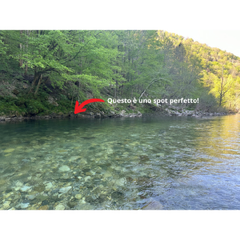
A virtually inaccessible bank, vegetation and large stones. Hard to find better.
Optimizing efforts
Tackling large expanses of water can seem daunting, but dividing the river into sectors helps identify the most promising areas. Instead of aiming for mile-long casts, it is better to focus on closer areas and work at short distances, trying to beat the really fishable spots as best you can.
The big holes: a dream and a challenge
Large deep holes are a dream for many anglers, but they rarely prove productive for fly fishing. These spaces are often resting places for fish rather than hunting. However, the heads and tails of these holes can hide active fish looking for food. To increase the odds, I recommend the use of bulky flies such as Mauro Alberti’s Neurostreamers or super leaded jigs.
Conclusion
Fishing for big trout requires experience, concentration and the ability to read the water. It is not enough to beat the whole river: you have to focus on the details, optimizing efforts and strategies. The best surprises come when you observe discontinuities and approach spots methodically and carefully. In this way, even the most challenging rivers can yield unexpected catches.